 Hustle EmpireBuild a business
Learn business.
Build empires.
Run a business simulation you learn by playing: supply chains, prices, staff and logistics — then trade with the rest of the town for what you cannot serve alone.
Free to play. No card, no email address required.
One street, every business on it. You start with a counter; the rest are opened with the money it makes.
Your first four moves
Open a business
Your first one is already open and stocked — pick it on the street.
Make your first sale
Set a price, then tap Serve when a customer is waiting. Cash goes up.
Reinvest
Buy an upgrade or more stock so you can serve more customers.
Expand
Open a second business with the money the first one earned.
How to play, in one minute
You start with a little cash and one small business. Sell to customers, spend the profit on better equipment and stock, open more businesses, and look after yourself along the way.
Controls
- Move: Arrow keys, or tap a spot on the street.
- Act: Walk up to a shop, stall or person, then press the button that appears.
- Look around: The tabs along the bottom open each part of your empire.
Words you will see
- Cash:
- Money you can spend right now.
- Stock:
- Goods you hold to sell. When it runs out, you cannot serve customers.
- Needs:
- Energy, hunger and mood. When they drop, you work worse — rest and eat.
- Cash lasts:
- How many days your cash can pay your businesses' daily costs.
- Objective:
- The next useful thing to do. It stays on screen so you are never lost.
A guest game is kept on this device for 24 hours. Create a free account at any time and everything you have built moves across and is kept permanently.
Once you are playing, the How to play button in the status bar reopens this guide.
Learn, build, compete, collaborate
Four things the simulation does, each of them a system you can open in your first session.
Learn real business
The mechanics are the curriculum: every lesson below is a system the game settles on the server, not a video about one.
- Supply chains — Buy an input, run the recipe, sell the output — each step is a priced row.
- Inventory and storage — Stock is counted in units and storage in weight, so overbuying blocks the next batch until you sell or add space.
- Pricing strategy — Your listing carries your asking price, and the market shows what buyers accepted.
- Staffing and equipment — Staff and upgrades change how fast a business produces and how much it turns out.
- Logistics — Deliveries move goods between players, and courier pay scales with distance and reliability.
- Business expansion — Reinvest profit into the next counter until the chain runs end to end.
Build wealth
Wealth here is simulated: in-game cash, assets and net worth. Nothing on this page is a claim about real earnings.
- Net worth — Cash plus what you own, recalculated as you trade and build.
- Business portfolio — Every counter, workshop and warehouse you run, with its level and current batch.
- Assets and capacity — Equipment, stock and storage — the three things that decide what you can make next.
Compete
The town is shared, so the contest is economic rather than a scoreboard: prices are public and reliability is recorded.
- Price — Every listing shows its asking price, so undercutting a neighbour is visible to everyone.
- Reliability — Punctuality and trader ratings decide who earns the next contract and the pay premium.
- Milestones — Objectives mark what you have outgrown, so progress is visible without a ladder.
Collaborate
Nobody runs a whole chain alone for long — the town is where the missing links are.
- Player market — Buy and sell stock with other traders, with the server holding the goods in escrow.
- Supply agreements — Standing orders commit a supplier to feeding your chain between market visits.
- Communities — Join a community and fund projects that change the street for everyone on it.
Collaborate with other players
The street is shared. The market, the couriers and the community projects work because other people are running businesses on it too.
- Trade resources with other players.
- Buy and sell in player markets, held in escrow by the server.
- Join community projects that fund something for the whole town.
- Specialise, and let someone else run the part of the chain you skip.
- Build supply networks together — your output is their input.
Pick the empire you are building
Six ways in, one street. Your answer changes what the game recommends first — every business stays openable whichever you choose.
Hospitality
Turn one food counter into the street's favourite name.
What this path gives youAgriculture
Grow what every kitchen in town needs.
What this path gives youRetail
Build a chain of successful stores.
What this path gives youLogistics
Own the warehouses and the routes everything moves on.
What this path gives youIndustrial
Build the goods every other business resells.
What this path gives youTechnology
Sell the services other businesses cannot run without.
What this path gives you
Your first minute, on screen
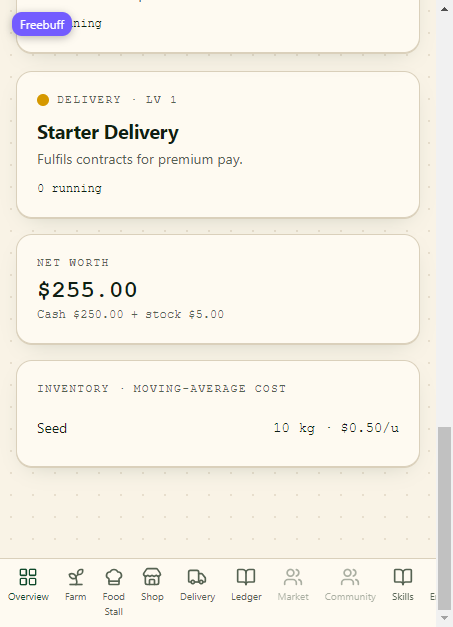
Captures from the game, not mock-ups: the street, a business workspace, the player market from both sides of a trade, and the same workspace on a phone.
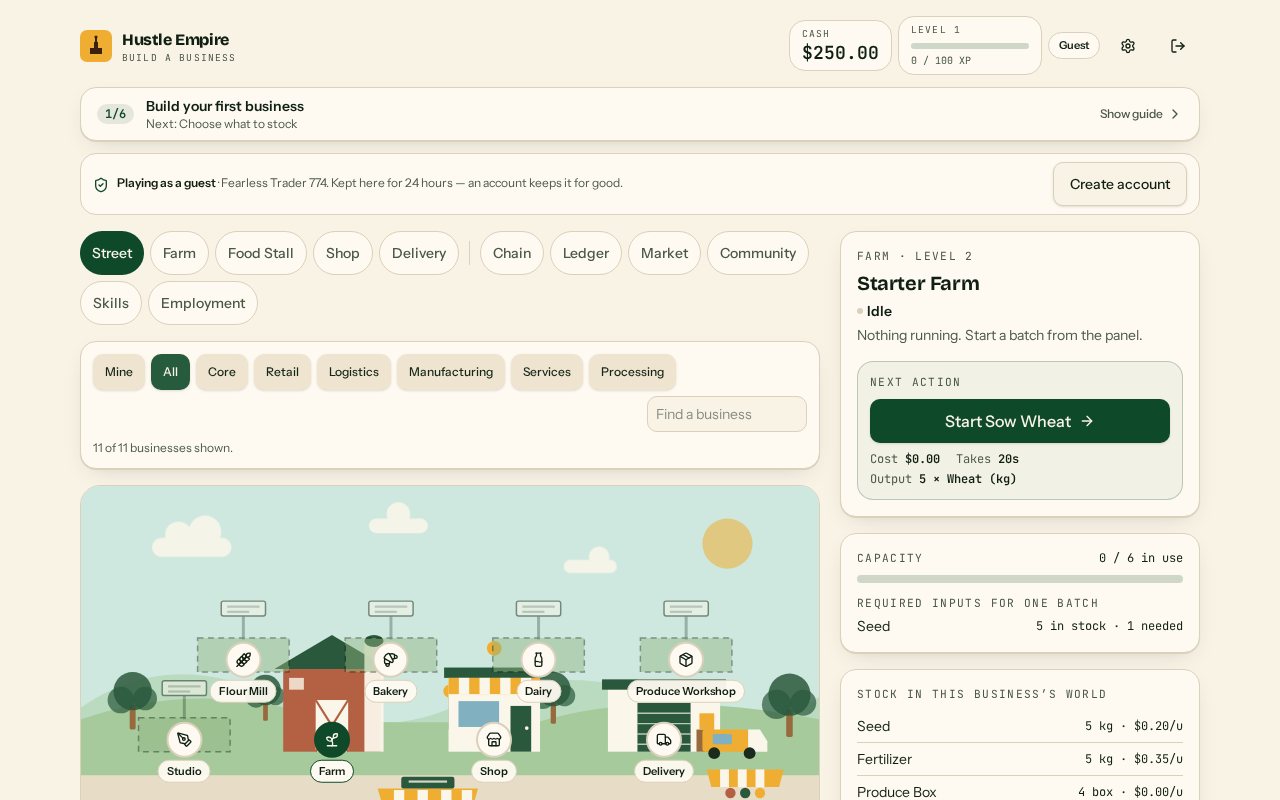
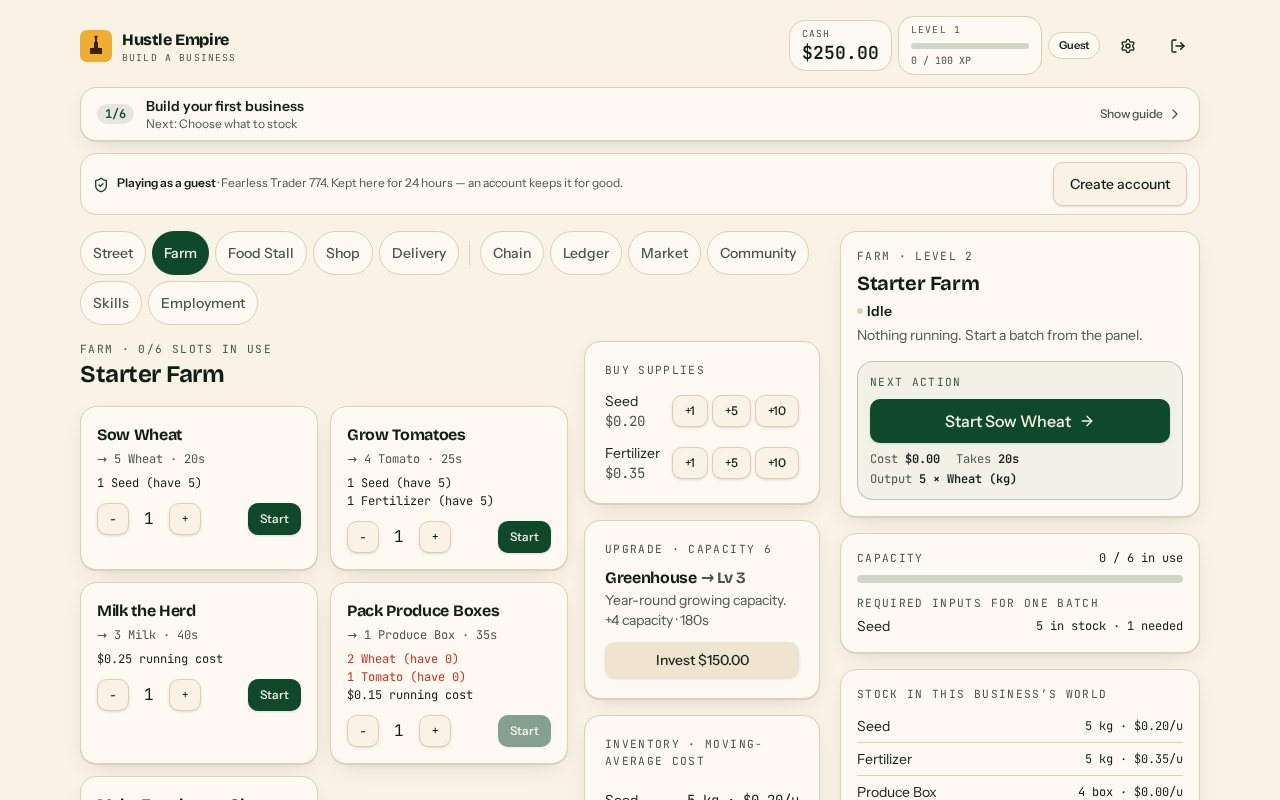
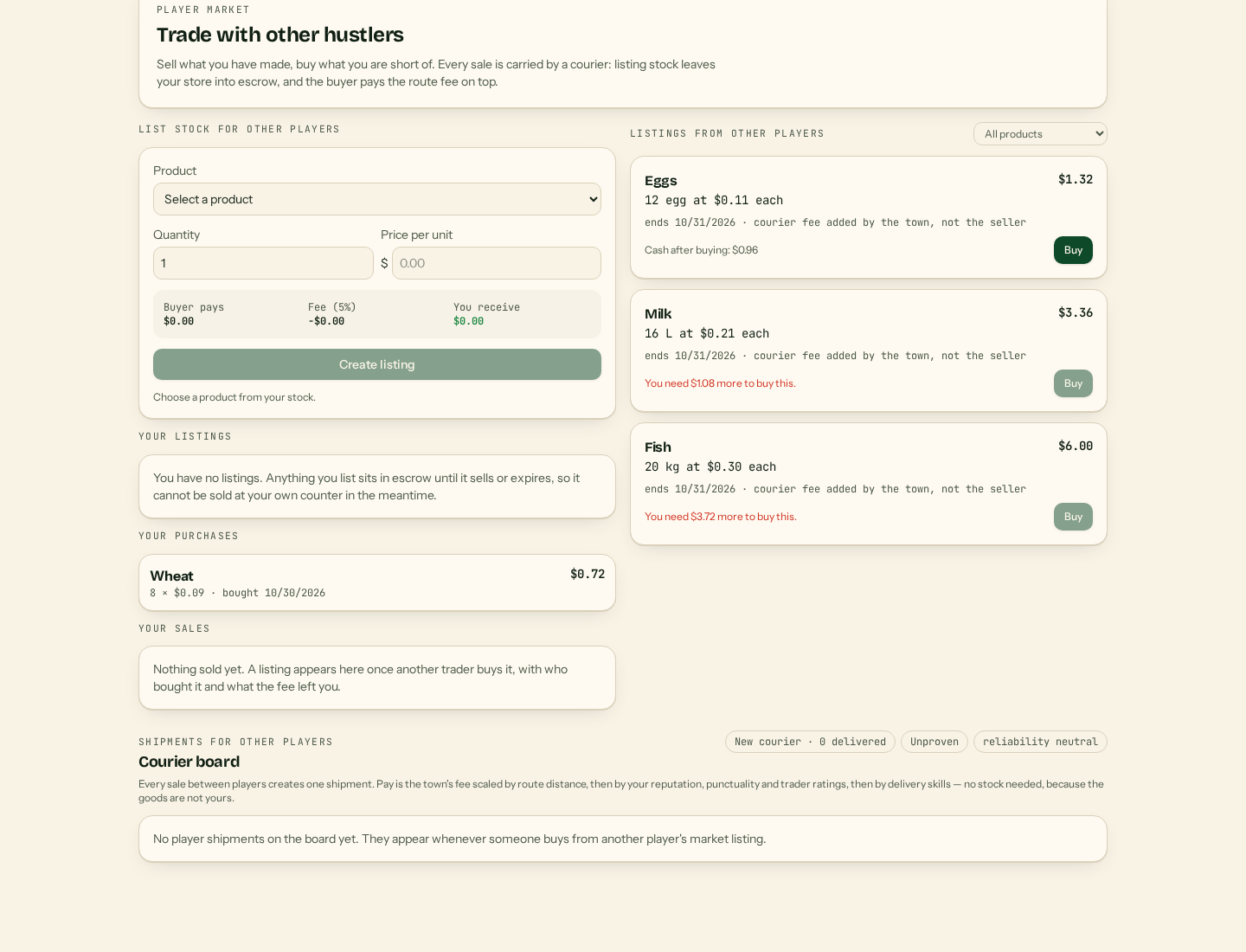
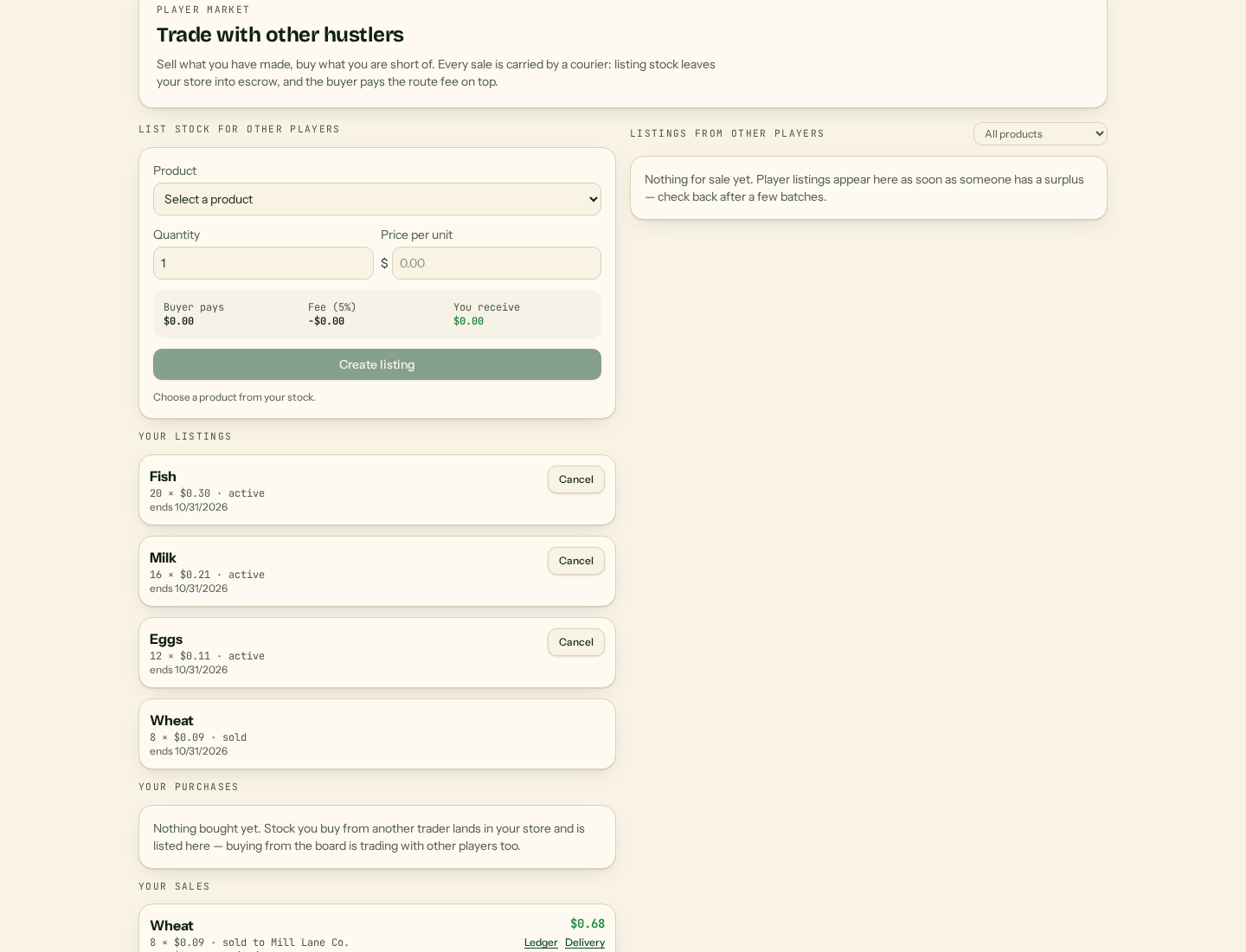
Make Your First Sale In Under A Minute
Your first business is free and already stocked. Signing up later keeps it.
Before your first sale
Do I need an account?
No. A guest session is a real business on the real economy — stock, customers and profit. It is kept on this device for 24 hours, and creating a free account moves it across and keeps it permanently.
What does it cost?
Nothing to play, and there is no pay-to-win: prices, demand and payouts are the same for every player. Anything optional that is ever sold sits outside the economy and is never a condition of playing.
What do I need to run it?
A browser. It is designed for a phone first and works with a keyboard and a screen reader.
Can I lose progress?
A guest business expires with its 24-hour session. An account keeps everything permanently and can export or delete its data at any time.